

Space Launch System (SLS)
Thrust: More than 8.8 million pounds at liftoff (most powerful rocket ever built).
Height: 322 feet (98 meters) tall—taller than the Statue of Liberty.
Engines: Four RS-25 core-stage engines (liquid hydrogen/oxygen) + two five-segment solid rocket boosters.
Payload to Moon: Up to 95,000 pounds (43 metric tons) to translunar injection orbit.
Stages: Core stage (derived from Shuttle tech) + Interim Cryogenic Propulsion Stage (ICPS) for final push to lunar trajectory.
Images courtesy of NASA
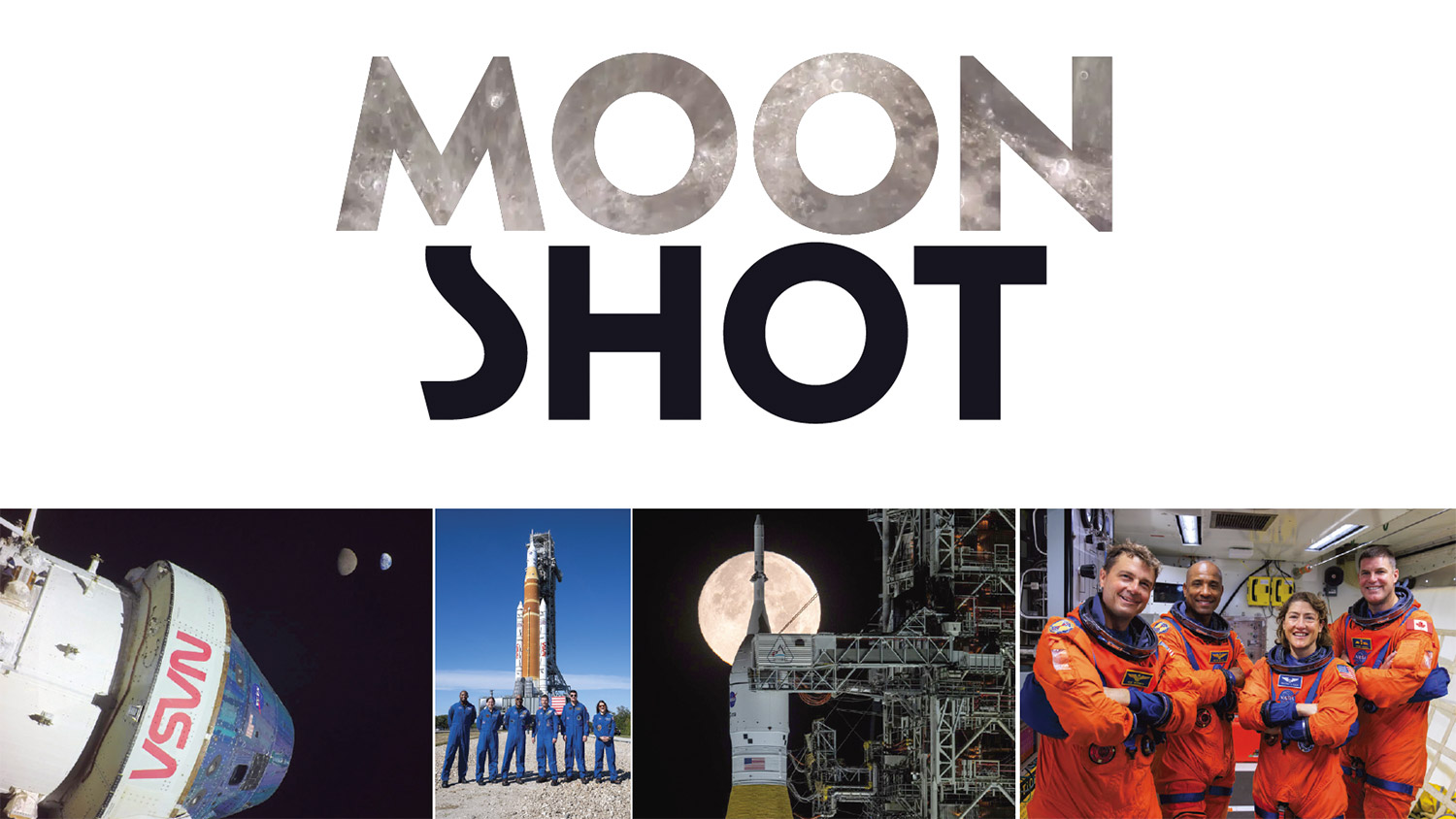
As humanity edges closer to a new era of space exploration, NASA’s Artemis II mission stands poised to propel four astronauts on a historic journey around the Moon—the first crewed lunar flyby since Apollo 17 in 1972. This pivotal test flight, part of the broader Artemis program, will validate the Orion spacecraft and the mighty Space Launch System (SLS) rocket for deep space operations, paving the way for sustainable lunar presence and eventual Mars missions.
Launching from Kennedy Space Center in Florida, Artemis II offers Central Florida a front-row seat to history, with the region’s residents witnessing the thunderous ascent of the SLS—boasting 8.8 million pounds of thrust—from Launch Complex 39B. The approximately 10-day mission begins with a high Earth orbit checkout, followed by a translunar injection that slingshots the crew toward the Moon. En route, they’ll test life support systems, navigation, and emergency procedures, while capturing breathtaking views of the lunar far side during a close flyby at about 4,600 miles.
“For All Humanity”
Commanded by veteran astronaut Reid Wiseman, the diverse crew includes pilot Victor Glover, mission specialist Christina Koch (who holds the record for the longest single spaceflight by a woman), and Canadian Space Agency’s Jeremy Hansen—marking the first Canadian to venture beyond low Earth orbit. Their international collaboration underscores Artemis’s global partnerships, with Europe’s Airbus-built service module providing propulsion and power.
During the free-return trajectory home, the astronauts will evaluate radiation shelters and conduct science experiments, gathering data crucial for future landings. Splashdown in the Pacific Ocean will cap this rehearsal for Artemis III’s crewed lunar touchdown.
Artemis II isn’t just a technical milestone; it’s a beacon of ambition, inspiring generations with lessons in innovation and unity. As preparations ramp up in early 2026, the mission reaffirms our drive to explore the cosmos, turning science fiction into reality.